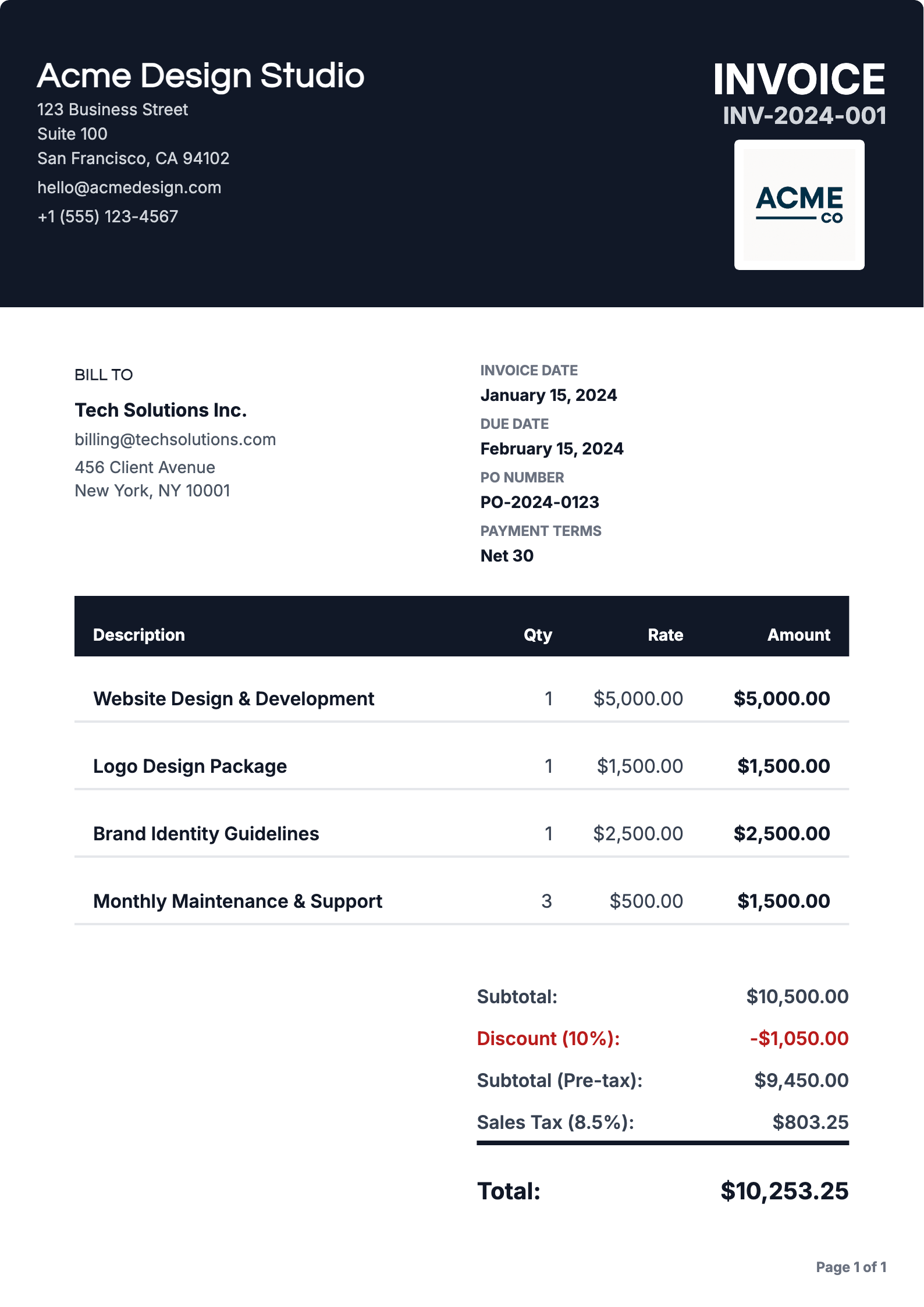
Quick answer
A proforma invoice is a preliminary bill sent before goods or services are delivered that shows the expected items, prices, and terms. It is not a demand for payment or a tax document; use it for customs, approvals, or deposits, then issue a final invoice.
What is a Proforma Invoice?
A proforma invoice (also spelled "pro forma invoice") is a document that provides a detailed breakdown of goods or services that will be provided, along with their prices, quantities, and terms. It's sent to the buyer before the actual shipment or delivery occurs, serving as a quotation or estimate that becomes binding once accepted.
The term "proforma" comes from Latin, meaning "for the sake of form" or "as a matter of form." Proforma invoices are commonly used in international trade, import/export transactions, and situations where advance payment or customs documentation is required.
Key Characteristics of a Proforma Invoice
Sent Before Delivery
Issued before goods are shipped or services are provided
Not a Payment Request
Serves as a quotation or commitment, not an actual bill
Common in International Trade
Widely used for customs clearance and import/export
Binding Agreement
Becomes a contract when accepted by the buyer
Proforma Invoice vs Regular Invoice: What's the Difference?
Proforma Invoice
- Timing: Sent before goods/services are delivered
- Purpose: Quotation, estimate, or commitment to sell
- Payment: Not a request for payment (though may request advance payment)
- Legal Status: Becomes binding when accepted
- Use Cases: International trade, customs, advance payments, quotations
- Accounting: Not recorded as accounts receivable until goods are delivered
Regular Invoice
- Timing: Sent after goods/services are delivered
- Purpose: Request for payment for completed work
- Payment: Direct request for payment
- Legal Status: Legally binding request for payment
- Use Cases: Standard billing, payment collection, accounting records
- Accounting: Recorded as accounts receivable immediately
When to Use a Proforma Invoice
International Trade and Import/Export
Proforma invoices are essential for international transactions. They're required for:
- Customs Clearance: Customs authorities use proforma invoices to assess duties and taxes before goods arrive
- Import Licenses: Many countries require proforma invoices to obtain import permits
- Letter of Credit: Banks need proforma invoices to open letters of credit for international payments
- Shipping Documentation: Freight forwarders and shipping companies use them for logistics planning
Advance Payment Requests
When you need payment before shipping goods or starting work, a proforma invoice provides the buyer with:
- Clear breakdown of what they're paying for
- Total amount due upfront
- Payment terms and instructions
- Documentation for their accounting records
Quotations and Estimates
Proforma invoices serve as detailed quotations that:
- Provide itemized pricing for potential orders
- Help buyers make purchasing decisions
- Lock in prices and terms before production begins
- Serve as a formal offer that can be accepted or negotiated
Pre-Shipment Documentation
Before goods are manufactured or shipped, proforma invoices help:
- Confirm order details and specifications
- Secure buyer commitment before production
- Plan logistics and shipping arrangements
- Obtain necessary permits and licenses
Every invoice template includes Proforma support.
Create proforma invoices on any plan - including free accounts.
What to Include in a Proforma Invoice
Essential Information
A professional proforma invoice should include:
- Header: Clearly marked "PROFORMA INVOICE" (not "INVOICE")
- Proforma Invoice Number: Unique reference number (e.g., "PRO-2024-001")
- Date: Date the proforma invoice is issued
- Seller Information: Your business name, address, contact details, tax ID
- Buyer Information: Customer's name, shipping address, billing address
- Itemized List: Detailed description of goods/services, quantities, unit prices, totals
- Shipping Details: Shipping method, delivery terms (FOB, CIF, EXW, etc.), estimated delivery date
- Payment Terms: Payment method, advance payment requirements, balance payment terms
- Total Amount: Subtotal, taxes, shipping costs, final total
- Validity Period: How long the proforma invoice is valid (e.g., "Valid for 30 days")
- Notes: Special instructions, terms and conditions, disclaimers
Step-by-Step: How to Create a Proforma Invoice
Step 01: Gather Required Information
Before creating your proforma invoice, collect:
- Buyer's complete contact and shipping information
- Detailed description of goods or services to be provided
- Quantities, unit prices, and specifications
- Shipping method and delivery terms (Incoterms)
- Payment terms and advance payment requirements
- Any special requirements or certifications needed
Step 02: Choose a Proforma Invoice Template
Select a professional template that clearly indicates it's a proforma invoice:
- Use online invoice generators like Invoice Website that support proforma invoices
- Ensure the template has space for all required international trade information
- Make sure it's clearly labeled "PROFORMA INVOICE" to avoid confusion
Pro Tip
Using a professional invoice generator ensures your proforma invoice includes all necessary fields and maintains a consistent, professional appearance that builds trust with international buyers.
Step 03: Add Business and Buyer Information
Include complete details for both parties:
- Your Business: Name, address, phone, email, tax ID, business registration number
- Buyer: Company name, contact person, billing address, shipping address (if different)
- For International Trade: Include country codes, postal codes, and any required customs information
Step 04: List Goods or Services in Detail
Provide comprehensive item descriptions:
- Product names, model numbers, SKUs
- Detailed specifications (size, color, material, etc.)
- Quantities for each item
- Unit prices and line totals
- HS codes (Harmonized System codes) for customs
- Country of origin for each item
Step 05: Specify Shipping and Delivery Terms
For international trade, include:
- Incoterms: Standard trade terms (FOB, CIF, EXW, DDP, etc.) that define shipping responsibilities
- Shipping Method: Air freight, sea freight, courier, etc.
- Estimated Delivery Date: When goods are expected to arrive
- Port of Loading/Discharge: For sea freight transactions
- Shipping Costs: If included in the price or separate
Step 06: Set Payment Terms
Clearly state payment expectations:
- Advance payment percentage (if required)
- Balance payment terms (before shipment, upon delivery, etc.)
- Accepted payment methods (wire transfer, letter of credit, etc.)
- Currency (especially important for international transactions)
- Bank account details for wire transfers
Step 07: Calculate Totals and Add Validity Period
Finalize your proforma invoice:
- Calculate subtotal, taxes, shipping, and final total
- Add a validity period (e.g., "This proforma invoice is valid for 30 days")
- Include any disclaimers or terms and conditions
- Review all information for accuracy
Skip the manual work. Try it free.
Invoice Website makes creating proforma invoices fast and professional.
Best Practices for Proforma Invoices
Clearly Label as "Proforma Invoice"
Always use the header "PROFORMA INVOICE" (not just "INVOICE") to avoid confusion. This makes it clear to buyers, customs officials, and banks that this is a preliminary document, not a request for immediate payment.
Include Validity Period
Always specify how long the proforma invoice is valid:
- Prevents buyers from using outdated pricing
- Protects you from price fluctuations
- Encourages timely decision-making
- Common validity periods: 15, 30, 60, or 90 days
Use Proper Incoterms for International Trade
For international transactions, use standard Incoterms (International Commercial Terms) like FOB (Free On Board), CIF (Cost, Insurance, and Freight), EXW (Ex Works), or DDP (Delivered Duty Paid). These terms clearly define who pays for shipping, insurance, and customs duties, preventing disputes.
Be Detailed and Accurate
Provide comprehensive product descriptions, specifications, and quantities. Accuracy is crucial because proforma invoices are used for customs clearance, and discrepancies can cause delays, additional fees, or shipment rejections.
Match Proforma to Final Invoice
When you eventually send the actual invoice after delivery, it should match the proforma invoice in terms of items, quantities, and prices (unless changes were agreed upon). This ensures smooth payment processing and maintains trust with your buyer.
Common Proforma Invoice Mistakes to Avoid
Common Mistakes
- Not Clearly Labeling as Proforma: Using "INVOICE" instead of "PROFORMA INVOICE" causes confusion
- Missing Validity Period: Without an expiration date, buyers may try to use outdated pricing
- Incomplete Product Descriptions: Vague descriptions cause customs delays and shipping errors
- Incorrect Incoterms: Using wrong or missing Incoterms leads to disputes about shipping costs
- Missing HS Codes: Customs authorities need Harmonized System codes for classification
- Currency Not Specified: Always state the currency to avoid payment disputes
- Inaccurate Totals: Calculation errors damage credibility and cause payment delays
- Outdated Information: Using old buyer addresses or contact information
Proforma Invoice for International Trade
Special Requirements for International Transactions
When creating proforma invoices for international trade, you may need to include additional information:
- HS Codes (Harmonized System Codes): Standardized product classification codes required by customs
- Country of Origin: Where the goods were manufactured or produced
- Incoterms: Standard trade terms defining shipping responsibilities
- Currency: Clearly specify the currency (USD, EUR, GBP, etc.)
- Port Information: Port of loading and port of discharge for sea freight
- Weight and Dimensions: Gross weight, net weight, and package dimensions
- Certifications: Any required certificates (CE marking, FDA approval, etc.)
Create Professional Proforma Invoices
Ready to Create Your Proforma Invoice?
Creating professional proforma invoices doesn't have to be complicated. With Invoice Website, you can generate professional proforma invoices that include all the necessary information for international trade, customs clearance, and business transactions.
Key Benefits:
- Professional templates clearly labeled as "Proforma Invoice"
- All fields needed for international trade and customs
- Easy customization and branding options
- PDF export for easy sharing and printing
- Sequential numbering for tracking
Ready to streamline your international trade documentation? Sign up for Invoice Website today and start creating professional proforma invoices in minutes.
Frequently Asked Questions
Is a proforma invoice legally binding?
No. A proforma is a good-faith statement of expected costs, not a request for payment or a contract. The binding document is the final commercial invoice issued after delivery.
When should I send a proforma invoice?
Send one when a client needs internal approval before ordering, when customs requires a declared value for shipping, or when you want to collect a deposit before work starts.
Should a proforma invoice have an invoice number?
Give it a reference number for tracking, but keep it outside your official invoice sequence and label it clearly as "Proforma" so it is not mistaken for a tax invoice.
What is the difference between a proforma invoice and a quote?
Both state prices before work begins. A proforma is formatted like an invoice and is often used for customs or approvals, while a quote is a sales document the client accepts to start the project.